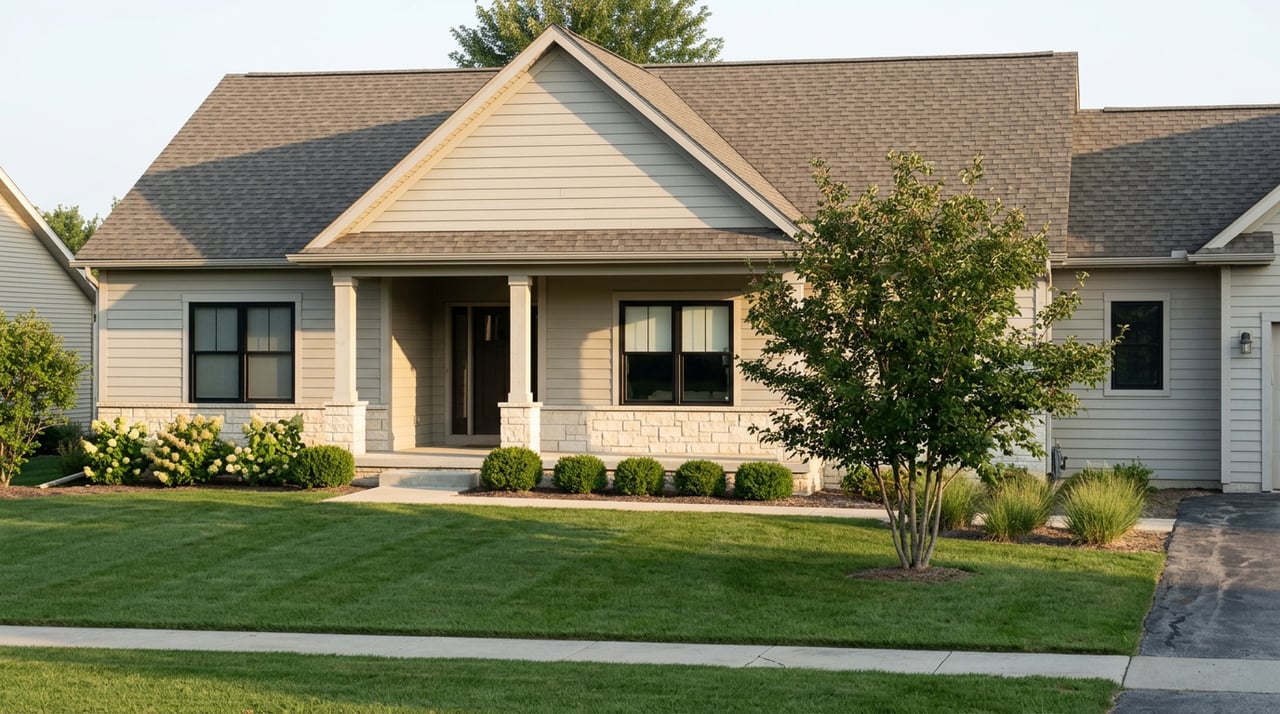
If you have checked an online home value estimate for a Manteno address this year, you have probably seen a number that looks like great news. As of March 2026, the median sale price for a home in Manteno stood at $334,000, up 35.2 percent from a year earlier. That is the kind of headline figure that makes a homeowner start mentally spending equity and makes a buyer wonder if they missed their window.
Here is the number that same data set showed right next to it: the median sale price per square foot in Manteno was $165, down 6.3 percent over the same twelve months.
Both of those numbers came from the same market, the same month, the same source. Neither one is wrong. But only one of them tells you what a typical Manteno home is actually worth today, and it is not the one getting quoted in casual conversation.
The Number Everyone Repeats
A 35 percent jump in median sale price sounds like a market that has caught fire. In a city the size of Chicago, a swing like that across thousands of monthly transactions would be genuinely remarkable. In Manteno, it is a different kind of signal.
Manteno recorded 11 home sales in March 2026, compared with 5 in March 2025. That is not a large enough sample to describe a trend so much as it is a sample small enough that a handful of higher-priced closings can single-handedly move the median. If two or three larger, newer, or more heavily upgraded homes happen to close in the same month as a few modest starter homes, the midpoint of that list shifts even though no individual home's value did anything unusual.
That is the quiet trap in median-price headlines for small markets. The median tracks which homes sold, not how much any specific home appreciated.
The Number Underneath It
Price per square foot solves for exactly that distortion, because it normalizes for size. A $450,000 home on 2,800 square feet and a $220,000 home on 1,300 square feet can both post a healthy per-square-foot number without either one skewing the picture the way a raw sale price can.
That is why the 6.3 percent decline matters more than it sounds like it should. It suggests that, square foot for square foot, Manteno homes were actually costing buyers slightly less in March 2026 than they did a year earlier, even as the median sale price climbed by more than a third.
Average days on market moved too, from 39 days a year earlier to 54 days as of March 2026. That is a modest cooling, not a stall, but it reinforces the same story: this is not a market where every home is suddenly worth dramatically more. It is a market where the mix of what is selling has shifted.
Why a Market This Size Can Show You Two Truths at Once
The volatility does not stop at price. Other public listing snapshots from mid-2026 showed a median sale price around $307,500, down roughly 2 percent year over year, essentially the opposite direction from the 35 percent figure above. A separate snapshot from June 2026 put the median list price at $357,000 with a typical 59 days on market, while an April 2026 snapshot from the same source showed homes sitting for a median of 146 days, nearly two and a half times longer.
Here is a side-by-side look at how much these figures moved within the same few months:
| Snapshot period | Metric | Reading |
|---|---|---|
| March 2026 | Median sale price | $334,000 (up 35.2% YoY) |
| March 2026 | Median price per square foot | $165 (down 6.3% YoY) |
| April 2026 | Median days on market | 146 days |
| June 2026 | Median days on market | 59 days |
| August 2026 | Active single-family listings, average list price | $360,703 across 31 homes |
None of these numbers are fabricated or cherry-picked to mislead. They are what happens when a village-sized housing market gets measured with tools built for cities. Manteno simply does not generate enough monthly closings for a single median or a single days-on-market figure to behave the way it would in a market ten times its size. Read any one of these numbers alone and you could talk yourself into a story that the data, taken together, does not actually support.
What's Actually Reshaping the Mix
If the median is being pulled around by which homes happen to sell in a given month, the more useful question is what is changing about who is buying and what they can afford. In Manteno, the answer traces back to a $2 billion battery and energy-storage manufacturing plant that has been ramping up on the village's western edge for the past two years.
Gotion Illinois converted a long-vacant 1.5 million-square-foot former Kmart distribution center into a manufacturing hub, and its hiring trajectory has been steep. The plant employed around 300 workers in late 2025, with plans to reach 450 by the end of that year and a stated goal of tripling its workforce toward roughly 1,400 jobs sometime in 2026, which would make it Kankakee County's largest manufacturer. Wages at the site range from about $24 an hour for production roles up to $42 an hour for more specialized positions, on top of benefits.
"We will make what the market demands," Mark Kreusel, Gotion Illinois' vice president of manufacturing, said of the plant's production schedule in comments reported by the Daily Journal.
A wage floor in the mid-$20s an hour, layered on top of higher-paid engineering and management roles also based at the site, is exactly the kind of local income growth that supports move-up buying and new construction, both of which tend to sell at a premium to the existing housing stock. That is a plausible mechanical explanation for why the median can rise even while the typical existing home, priced per square foot, holds steady or softens slightly. New construction and larger move-up purchases pull the median up. They do not necessarily reprice the three-bedroom ranch down the street.
Who's Actually Buying, and Who Isn't
One reasonable worry when a market posts a headline number like a 35 percent price jump is that outside investors or speculative buyers are driving it. The migration data does not support that story for Manteno. In the fourth quarter of 2025, only about 3 percent of nationwide home searches for Manteno came from buyers located outside the surrounding metro area, and 82 percent of Manteno's own homeowners who were house hunting elsewhere wanted to stay within the same metro. The inbound interest that did exist skewed toward buyers from other modest-sized Illinois metros, Rockford, Peoria, and Springfield among them, not from higher cost-of-living markets looking to cash out and relocate.
That points toward a locally driven market rather than a speculative one. The buyers pushing new construction and move-up purchases appear to be largely local, plausibly including households benefiting from the wage growth at Gotion, rather than outside capital chasing appreciation.
What This Means If You're Buying or Selling
If you are selling an existing home in Manteno right now, the headline median is not a pricing strategy. Pricing off a 35 percent year-over-year jump without accounting for what actually sold in that sample risks listing well above what comparable homes, matched for size and condition, are supporting. The per-square-foot figure, applied carefully to your specific home's size and updates, is a sturdier starting point than a citywide median built on a dozen transactions.
If you are buying, the more useful lens is what specific homes in your size range and price point have actually closed for recently, not the aggregate headline. A market where days on market can swing from 59 to 146 within a few months is a market where patience and local comparables matter more than timing a citywide trend.
Either way, the Gotion expansion is worth watching over the next year, not because it is inflating every home's value uniformly, but because it is changing who is in the buyer pool and what they can afford to build or move up into. That shift shows up first in the mix of what sells, long before it shows up as a clean, believable trend line in any single median.
Common Questions
Does a falling price-per-square-foot mean Manteno home values are dropping? Not necessarily. It means that, adjusted for size, the typical home was not appreciating as fast as the raw median sale price suggested as of March 2026. A modest per-square-foot decline alongside stable or growing demand is different from a market in outright decline.
Should I wait to sell until the median price climbs further? The median is sensitive to which homes happen to close in a given month, not to a broad repricing of the existing stock. Waiting on a citywide median to move in your favor is a weaker strategy than pricing your specific home against recent, comparable closings.
Is the Gotion plant's hiring timeline guaranteed? The stated goal was for the workforce to more than triple toward roughly 1,400 jobs sometime in 2026, based on company and village statements reported through late 2025. Hiring plans at any single employer can shift, so it is worth treating that number as a direction rather than a fixed date.
If you are trying to make sense of what a specific Manteno property is actually worth in a market this noisy, that is exactly the kind of pricing question worth a real conversation rather than a screenshot from an estimator. Leanne Provost works Kankakee County listings and closings year-round and can walk through what your home's size, condition, and location actually support in today's mix, not just what the headline number says. Reach out to schedule a consultation or request a current, comparable-based valuation before you price your next move.


